
When a storm blows through and you hear something come off the roof, or notice water dripping through the ceiling, it’s natural to want someone out straight away. An emergency roofer can help, but it’s worth knowing what they can realistically do while the weather is at its worst, what you can safely do yourself in the meantime, and what happens once the storm has passed.
This guide covers all three, so you know what to expect if you need an emergency roofer in Wakefield, Ossett, Horbury or anywhere nearby.
Your safety comes first
Whatever has happened to the roof, the people in the house matter more. The government’s Be Ready storm guidance says you should not go outside to repair damage to your property while a storm is in progress. That means no climbing onto the roof, no going up a ladder to look at slipped tiles, and no trying to hold down a flapping piece of felt in the wind.
A few other points to keep in mind:
- Stay indoors where you can, and keep internal doors closed.
- Keep away from damaged walls, chimneys and anything that looks unstable, both during and after the storm.
- Don’t touch electrical or telephone cables that have come down or are left hanging. Keep well clear and report them.
We’ve covered the risks of roof access in more detail in Is It Safe to Get on My Roof?, but during a storm the answer is simple: stay off it.
Before the storm arrives
The Met Office issues yellow, amber and red weather warnings. As the Met Office explains, these are based on the likely impact of the weather rather than fixed wind speeds, with red reserved for the most severe weather. If a warning covers your area, a bit of preparation goes a long way:
- Secure loose items such as garden furniture, trampolines, bins and ladders, which can be blown into windows or onto roofs.
- Close and fasten doors and windows, especially those facing the wind.
- Move cars away from trees, walls and fences if you can.
- Charge your phone and save your roofer’s and insurer’s numbers somewhere easy to find.
If you want to understand how wind relates to roof damage, our post on what wind speed is dangerous for your roof goes into that in more depth.
If water is coming in
A leak during a storm can spread quickly, but there’s a lot you can do from inside the house without putting yourself at risk:
- Move furniture, electrical items and anything valuable away from the leak.
- Put buckets or other containers under drips, and lay towels or old sheets down to soak up water and protect floors.
- If a ceiling is sagging or bulging with water, keep everyone out of the room underneath.
Water and electrics
Water near lights, sockets or the consumer unit needs care. Electrical Safety First’s flooding guidance advises switching off the electricity at the consumer unit (fuse box) only if it is safe to do so, and getting advice from a registered electrician if there is any sign of water inside it. If reaching the fuse box would mean standing in water or touching wet switches, leave it alone and get help.
Speak to your insurer early
If the damage looks significant, contact your home insurer as soon as you can. The Association of British Insurers advises getting in touch with your insurer as soon as possible. It also says that if temporary emergency repairs are needed to stop damage getting worse, you should speak to your insurer first, and keep any receipts, as these will form part of your claim. Many insurers have 24-hour claims lines.
It’s also good practice to take photos of the damage, inside and out, as long as you can do it safely from indoors or from the ground. Note who you’ve spoken to and when.
What an emergency roofer can do
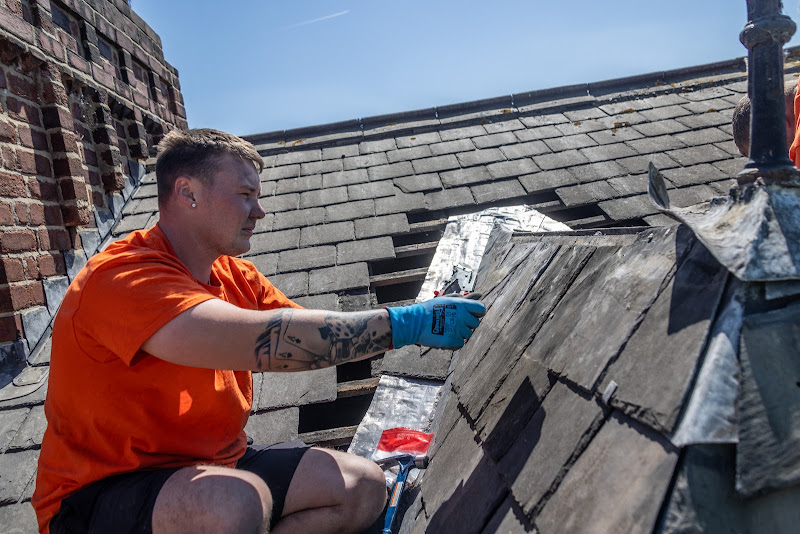
An emergency call-out is about stopping things getting worse, not usually about finishing a full repair there and then. The aim is to make the roof safe and watertight until a permanent repair can be done.
Depending on the damage, the weather and how safely the roof can be reached, an emergency roofer may be able to:
- Assess the damage and any risk to people, neighbouring properties and the public.
- Make safe anything loose that could fall, such as slipped tiles, slates or ridge pieces, once it is safe to get to them.
- Carry out a temporary repair to keep the weather out, where conditions allow work on the roof.
- Explain what has failed and what is likely to be needed for a permanent fix.
Why roof work sometimes has to wait
Whether work can go ahead straight away depends on safety and conditions. Roofers won’t go up in dangerous winds, and heavy rain or ice can make a roof too risky to work on. The Health and Safety Executive expects work at height to be properly planned, supervised and carried out by competent people, and that doesn’t change because it’s an emergency.
In practice, that can mean the first step is assessing the damage from the ground or from inside, with work on the roof itself following once the wind drops. DPR’s high-level access equipment is used for jobs including storm damage and emergency work, though whether it can be used still depends on the conditions on the day.
What to tell the roofer when you call
A few details at the start help the roofer understand the problem and plan a safe visit:
- Your address and the best number to reach you on.
- Where the water is coming in and which room it’s affecting.
- The type of roof: pitched with tiles or slates, a flat roof, or a mix, and how many storeys the building has.
- Any damage you can see from the ground, such as missing tiles, a leaning chimney, a torn flat roof covering or gutters hanging loose.
- Access: whether there’s parking or a driveway, and anything that could make the roof hard to reach, such as a conservatory, extension or overhead cables.
- Whether the electrics have been affected, or anyone in the property is vulnerable.
After the storm
Once the weather has settled, the roof should be properly inspected, even if a temporary repair seems to be holding.
Some storm damage only shows itself later. A tile that has cracked or lifted slightly, flashing that has been pulled away, or a ridge that has been disturbed might not leak until the next spell of heavy rain. Over the following weeks, keep an eye on ceilings and upstairs walls for damp patches or staining.
Permanent repair options
What happens next depends on what the inspection finds. A permanent roof repair might be as straightforward as replacing a few tiles or slates, refixing a ridge, repairing flashing, patching a section of flat roof or refitting gutters. Where a roof was already in poor condition, a storm can expose wider problems, and a larger repair or partial re-roof may be the more sensible long-term option.
Either way, you should get a clear explanation of what’s wrong and what the options are, so you can make a decision and pass the details on to your insurer if you’re making a claim.
Storm damage to your roof? Talk to us
DPR Roofing offers a 24 hour emergency service on roof repairs, available seven days a week, to customers in Wakefield, Normanton, Outwood, Sandal and the surrounding areas. We’ll always tell you honestly what can be done straight away and what has to wait until it’s safe to work on the roof. If your roof has been damaged in a storm, call us on 01924 255 677 or get in touch online and tell us what’s happened.
We’re a family-run business and have been roofing since 1989, so we know what Yorkshire weather can do to a roof. We’ll tell you plainly what we’ve found and what needs doing.