
There’s a particular mood to November in Wakefield. Mornings arrive with a mist that hangs over Pugneys, canal paths glisten with overnight drizzle, and roofs across Sandal, Wrenthorpe and Walton stay damp long after the school run. By the time the wind picks up along Denby Dale Road or a sharp shower rolls through Ossett, any small weakness in a roof begins to show itself.
That’s why November is the month when certain roof repairs suddenly become very familiar. Cold nights, heavy dew, tree debris and the start of real winter weather all combine to test every tile, joint and gutter. Below is a local Wakefield guide to the repairs we see most often at this time of year, why they happen and what a homeowner can safely look out for from the ground.
1. Slipped or cracked tiles
Tiles that survived summer heat and early autumn rain can reveal their true condition in November. Cooler nights shrink them back, strong gusts lift their edges and water finally finds its way underneath.
Common patterns across Wakefield:
- Concrete tiles on estates around Kettlethorpe and Outwood often show small cracks at the lower edges.
- Clay tiles in older parts of Ossett or Horbury can shift slightly as mortar beds age.
- Slate roofs on period terraces near the city centre frequently show individual slates working loose when fixing nails deteriorate.
From the ground, you might spot a tile sitting proud, a darker patch where underlay is showing or a slightly wavy roofline. These are all signs that a professional should take a closer look before winter storms arrive.
2. Leaking or lifted lead flashings
If November had a favourite weak point to expose, it would be chimney flashings. Cold conditions firm up old lead, wind tries to lift it, and rain driven across the Calder Valley directionally pushes water into even the tiniest gaps.
Where this commonly appears:
- Around chimneys on terraced properties in Agbrigg and Belle Vue.
- Behind dormers on conversions in Thornes Park and Lupset.
- On older garages and extensions where flashing was once “patched” rather than replaced.
Tell-tale signs:
- Bright green or rusty streaks down the chimney face.
- Damp patches below the stack inside the loft.
- A fine shadow line where flashing no longer sits snug against brickwork.
Flashings are always a professional repair. A poorly sealed joint in November can become a persistent winter leak.
3. Blocked and overflowing gutters
Wakefield wears its trees proudly, but by November their leaves have travelled straight into gutters across Newmillerdam, Wrenthorpe and Walton. Moss from roofs, small twigs from sycamores and general autumn clutter combine to choke outlets.
Why this matters so much in November:
- The sun sits lower, so damp areas take longer to dry.
- Overflowing gutters soak fascia boards and brickwork.
- Saturated eaves can let wind-driven rain up under the tiles.
If you see water cascading over a gutter edge during a shower, or a persistent drip from a joint even after the rain stops, it’s time for a professional clean and check. It’s astonishing how many winter leaks begin with nothing more than a blocked downpipe.
4. Failing ridge and hip mortar
Roof ridges take the full force of November gusts, especially across exposed spots like Alverthorpe, Flanshaw or any property sitting higher up towards the motorway corridor. Older mortar beds crack, lift or hollow out, leaving ridge tiles vulnerable to movement.
Signs you can spot:
- A fine line of daylight where a ridge meets a tile course.
- Small mortar fragments on driveways or patios.
- A ridge tile that looks slightly skewed compared to the rest.
These are repairs best tackled early. Once the wind gets under a ridge tile, it doesn’t politely wait for spring.
5. Damp lofts and condensation issues
November is the crossover month when warm indoor air meets cold roof surfaces, creating ideal conditions for condensation. Many Wakefield homes notice this for the first time around mid month.
What it looks like:
- Beads of water on nail tips
- Darkening of felt around the rafters
- A musty smell, especially after a cold night
- Damp insulation along the eaves
These issues often develop on properties in shaded or tree lined areas such as parts of Sandal, Wrenthorpe or Newmillerdam, where roofs stay cool and damp.
Sometimes the cause is ventilation being blocked by slumped insulation. Other times, a failed underlay or lifted lap is allowing extra moisture in. A proper inspection reveals the difference.
6. Flat roof ponding and split seams
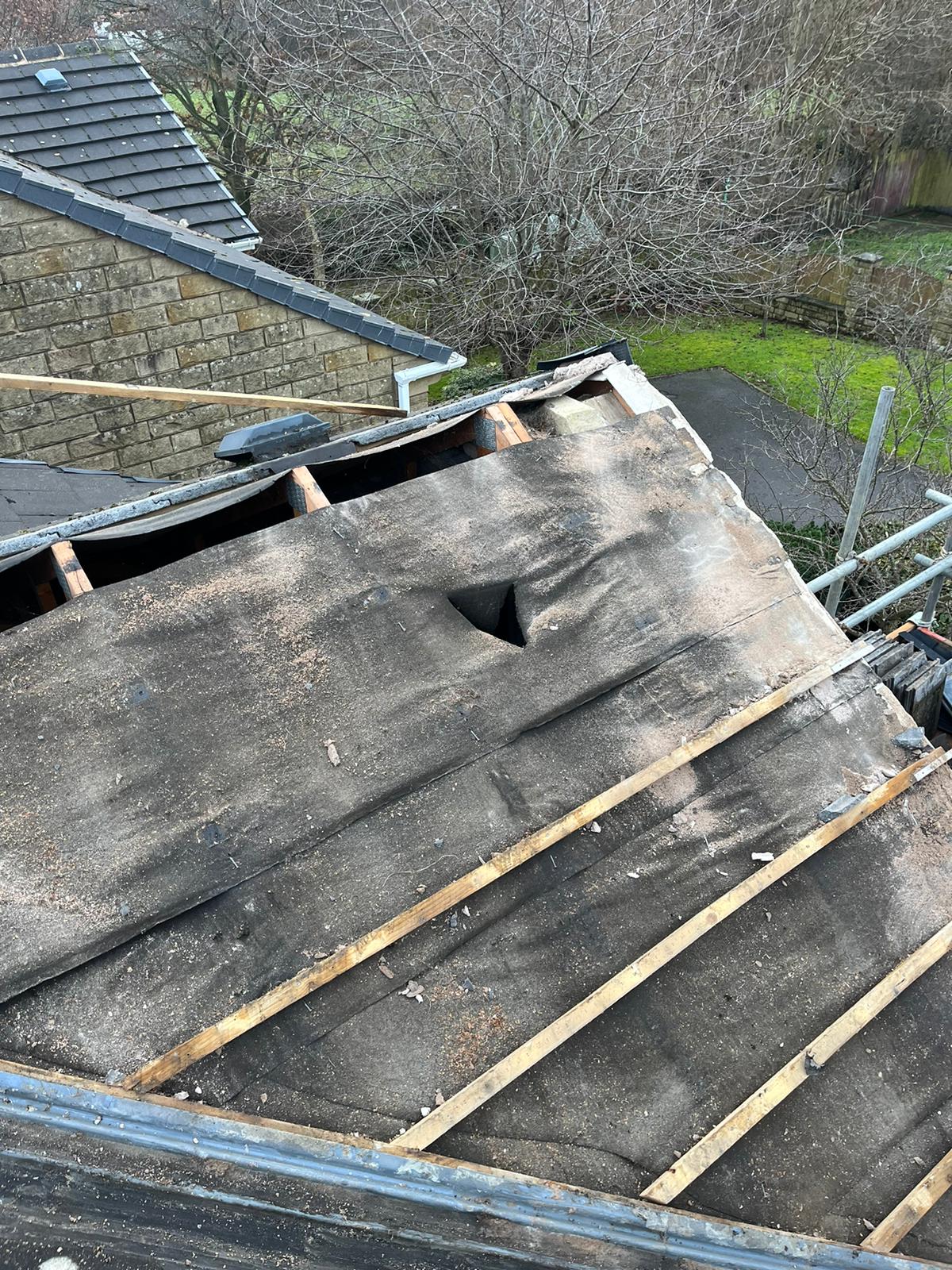
Dormers and flat roofs across Wakefield take a hammering in the autumn to winter transition. Felt that held up fine in summer becomes brittle in the cold. Outlets blocked with leaf debris cause puddles that linger for days.
Common November symptoms:
- Small blisters forming under the felt
- Water pooling in the same spot after each shower
- Hairline splits where two sections of felt meet
- Damp patches inside, usually on plasterboard ceilings below
We see this on older garage roofs, kitchen extensions and dormers around places like Eastmoor, Altofts and Lupset. Flat roofs tell the truth in November. If water doesn’t clear off them quickly, something needs attention.
7. Moss-heavy areas lifting tiles
Wakefield’s tree lined streets and shaded neighbourhoods make moss a frequent visitor. By November, the combination of moisture, cold and shorter days works in its favour.
The issue isn’t the colour, it’s the behaviour:
- Moss creeps under tile edges and lifts them
- It holds moisture against tile surfaces longer
- Fragments fall into gutters and valleys, causing blockages
- Heavily mossed tiles on shallow roofs become noticeably heavier
If you’re in pockets like Wrenthorpe, Horbury or Kettlethorpe, moss growth is particularly common. A roofer can remove it safely and complete a biocide treatment where appropriate. Pressure washing should never be used.
8. Loose verge caps on modern tiled roofs
Many newer estates around Outwood, Thornes, Durkar and Newton Hill use dry verge systems that cap off the tile edges. Over time, wind can work these loose, especially in November when gusts increase.
Symptoms include:
- A rattling noise during windy spells
- A cap that looks slightly lifted or crooked
- A visible gap between the verge piece and the tile beneath
Left unattended, wind can pull these off entirely. It’s a quick fix when caught early.
9. Valley repairs and debris clearance
Valleys are where two roof slopes meet, and in November they collect everything: moss, leaves, sticks, even the odd lost football from back gardens.
This debris blocks water flow during heavy showers. In areas with many mature trees, such as Sandal and Newmillerdam, it’s a common seasonal issue.
What you might see:
- A dark wet patch below the valley inside the loft
- Overflow where the valley meets the gutter
- Water tracking down the underlay during heavy rain
Valleys are delicate, so cleaning or repair here is always a job for trained roofers.
10. Re securing roofline elements (soffits, fascias and brackets)
As wind increases through November, anything already a little loose tends to announce itself. Soffit boards may rattle, fascia joints show gaps or downpipe brackets strain under repeated heavy rainfall.
These aren’t dramatic failures, but left untouched they lead to drafts, pests finding easy access or gutters eventually bowing out of alignment.
A quick professional fix now saves a lot of winter frustration.
Get ahead of winter with a November roof check
November may feel late in the year, but it’s actually one of the most revealing months for spotting issues before true winter sets in. Cold nights show up condensation problems. Rain exposes roofing weaknesses. Wind tests anything loose. And gutters carry the entire autumn’s worth of debris.
If something’s caught your eye, a drip, a stain, a loose looking tile or just a sense that something isn’t quite right, it’s worth getting it checked properly.
DPR Roofing Wakefield works across the district, from family homes in Horbury and Ossett to terraces near the city centre and leafy properties around Newmillerdam and Sandal. We bring safe access equipment, PCA trained technicians and clear, plain English assessments that help you prepare for whatever winter has planned.
If you’d like a calm, knowledgeable pair of eyes on your roof this November, get in touch with our team and we’ll take it from there.